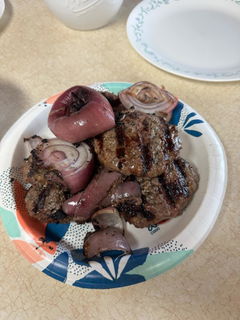
Grilled bison burger on a plate with radishes and purple cabbage on a wooden surface
Two raw bison burger patties on brown paper with a small bowl of spices and a clove of garlic.
A bison standing in a grassy field with mountains in the background
Man in a cowboy hat and jeans walking with two bison in a field under a cloudy sky.
Plated grilled bison with a sprig of rosemary on a wooden surface
Person spooning sauce over a bison steak in a cast iron skillet
Hightail Regenerative Ranch with American Grassfed logo over a scenic landscape.

Grass-Fed Ground Bison — 1 lb Brick | Hightail Ranch

Price
$28.05
$16.55 with Membership
Taxes and shipping calculated at checkout

Frequently Bought Together

Grass fed Ground Bison Product Information

Grass-fed ground bison from Hightail Ranch in Camas Prairie, Montana. One pound per brick, vacuum-sealed and flash-frozen.


Hightail Ranch raises bison the way bison are supposed to be raised — on 10,000 acres of Montana prairie, never grain, never hormones, never antibiotics, never even vaccines. The herd grazes rotationally on native grass year-round. We brought Hightail onto Valor because that standard matches ours.

Ground bison eats leaner than ground beef. It cooks faster, browns a little darker, and carries the deeper, slightly mineral flavor that bison is known for. It works in everything beef does — burgers, chili, tacos, meatballs, bolognese — but you'll want to pull it off the heat a minute or two sooner.


Weight

1 lb (16 oz) per brick

Cut

Ground bison (single-source, single-ranch)

Source

Hightail Ranch · Camas Prairie, Montana

Sourcing

Grass-fed and grass-finished · No hormones · No antibiotics · No vaccines

Certification

American Grassfed Association (AGA) certified

Pack

Vacuum-sealed brick, flash-frozen

Processing

Processed in a USDA-inspected facility

Shipping

Ships frozen with dry ice

How to cook Hightail ground bison

Bison runs leaner than beef — around 90/10 by default, sometimes leaner. The flavor is deeper and the cook is faster. Two rules cover most situations.

 Rule one: pull it sooner.

For burgers, target an internal temperature of 135–140°F for medium-rare to medium. We don't recommend going past medium with ground bison — the leanness shows up fast as dryness above 145°F. For chili, bolognese, tacos, or anything where bison gets cooked into a sauce or shell, brown it until just past pink and stop. The sauce finishes the cook.

Rule two: use the fat in the pan.

Bison doesn't render as much fat as beef.
Start with a hot pan, a splash of avocado oil or tallow, and don't crowd the
pan. If you're making burgers, brush the patties lightly with oil instead of
greasing the pan — that gives you the crust without drying the inside.

Three uses we send members to most often:

• Bison burgers — 6 oz patty, hot cast iron, 3 minutes per side for medium-rare, rest 4 minutes.

• Bison chili — brown 1 lb in a Dutch oven, build the chili around it. The leanness lets the chili lead without grease coating the spoon.

• Bison bolognese — sub 1:1 for beef, reduce simmer time by 15 minutes, finish with a small knob of butter for richness.

Why we partnered with Hightail Ranch

Hightail Ranch sits on 10,000 acres of Camas Prairie in Western Montana. Around 300 bison roam the land — that's roughly 33 acres per animal, in a category where conventional cattle stocking is closer to one or two acres per head. When Hightail says free-roaming, the math backs it up.

Jon Sepp and Brittany Masters built the operation from scratch. Jon spent his career in the military, testing parachutes; Brittany came from a corporate role in Seattle. Neither came from ranching families. Both are first-generation. They're veteran-owned and woman-owned, and they raise their herd with what they call low-stress handling — no interference outside of pasture moves and one annual run through the corrals to tag and health-check the animals.

Hightail's view, which is also ours: bison aren't just livestock. The way they graze and the way their hooves work the soil are part of what built the Great Plains in the first place. Without them, the ecosystem doesn't exist. Raising them well isn't sentimental — it's how the land gets restored.

That's the work we want on Valor. We don't put a ranch on the marketplace unless we'd buy from them ourselves, and Hightail clears that bar by a wide margin.

Nutrition & Sourcing

Bison runs higher in protein and lower in fat than the equivalent cut of beef. A 4 oz raw serving of Hightail ground bison delivers approximately 24 g of protein. The full nutritional profile depends on the specific cut and pack; see the panel on the brick for exact values.

Grass-fed AND grass-finished

No hormones, no antibiotics, no vaccines

AGA-certified (American Grassfed Association)

Single ranch, single source

Processed in a USDA-inspected facility

Grass Fed Ground Bison FAQ

The most popular questions about grass-finished ground bison meat.

How is ground bison different from ground beef?

Bison is naturally leaner — Hightail's ground bison runs around 90/10, sometimes leaner. The flavor is deeper and slightly more mineral than beef, with less of the rich beef fat that coats your tongue. Most members tell us bison reads as cleaner and more savory. In recipes, the biggest practical difference is the cook time: bison gets to medium-rare faster than beef and dries out faster past medium. Pull it sooner.

How do I cook ground bison without drying it out?

Two rules. First, pull it earlier than you would beef — 135–140°F internal for medium-rare burgers, and brown it just past pink for chili or sauces (the sauce will finish the cook). Second, bison renders less fat than beef, so use a hot pan, a splash of oil, and don't overcrowd. For burgers specifically, brush the patties with oil instead of the pan.

What's the leanness of Hightail Ground Bison?

Approximately 90/10 by default, sometimes leaner depending on the harvest. Check the panel on the brick for the exact ratio on your pack. The leanness is a feature of grass-fed bison, not a trim choice — Hightail's animals graze rotationally on native Montana prairie and never eat grain, which keeps the fat profile distinct from grain-finished beef.

What recipes work best with ground bison?

Burgers, chili, tacos, bolognese, meatballs, meatloaf, stuffed peppers, shepherd's pie — bison subs 1:1 for ground beef in nearly any recipe. We especially like it in chili and bolognese, where the leaner profile lets the other flavors lead. Recipe collection coming to the Valor journal soon!

How much protein is in a 4 oz serving?

Approximately 24 g of protein per 4 oz raw serving, with substantially less fat than the equivalent serving of ground beef. Exact values are on the panel on your brick.

Is Hightail bison grass-fed and grass-finished?

Yes — both. We've verified directly with Hightail Ranch that their bison are 100% grass-fed and grass-finished. They eat no grain of any kind, are raised without added hormones, without antibiotics,
and without vaccines. Hightail is certified by the American Grassfed Association (AGA), which is the standard we look for when evaluating any grass-fed claim.

Can I substitute ground bison for ground beef in any recipe?

In almost every case, yes — same volume, same prep. The two adjustments worth making: cook to a lower internal temperature (bison runs leaner and dries out past medium), and reduce the cooking time by about a minute per side for burgers, or by 10–15 minutes for long-simmer dishes like chili and bolognese. The flavor swap is straightforward — bison reads as a deeper, slightly more mineral version of beef.

Recommended for You