Plated dish of bison osso buco with carrots and mashed potatoes on a wooden table.
bison osso buco raw on a wooden cutting board with herbs and salt in the background
Jon Sepp Founder Hightail Ranch
Brittany Masters - Founder - Hightail Ranch
Cowboy from Hightail Ranch on dirt bike chasing buffalo in a Montana landscape at sunset.
Bison standing in a snowy landscape - Hightail Ranch
Hightail Regenerative Ranch with American Grassfed logo over a scenic landscape.

Bison Osso Bucco — Bone-In Shank, 16-18 oz | Hightail Ranch

Price
$59.51
$35.11 with Membership
Taxes and shipping calculated at checkout

Frequently Bought Together

Grass fed Ground Bison Product Information

Bone-in bison shank cross-cut for osso bucco (also spelled osso buco). 16 to 18 ounces per portion, from Hightail Ranch in Camas Prairie, Montana.


Hightail Ranch raises bison the way bison are supposed to be raised — on 10,000 acres of Montana prairie, never grain, never hormones, never antibiotics, never even vaccines. The herd grazes rotationally on native grass year-round. We brought Hightail onto Valor because that standard matches ours.

Osso bucco is the cut that turned bison from frontier food into restaurant food. A cross-cut shank with the marrow bone still in — slow-braised in wine and aromatics until the connective tissue collapses, the meat slides off the bone, and the marrow softens into a spoonable richness that gets folded back into the sauce. The bison version eats deeper than the veal version most cooks know. Same technique. Same result. More flavor.

This is a weekend cut. Three hours of mostly hands-off braising, in a Dutch oven or a slow cooker. The full recipe is below.


Specs strip

Weight

16-18 oz per portion — serves 1 generously, or 2 plated over polenta

Cut

Bone-in shank cross-cut (osso bucco / osso buco style)

Source

Hightail Ranch · Camas Prairie, Montana

Sourcing

Grass-fed and grass-finished · No hormones · No antibiotics · No vaccines

Certification

American Grassfed Association (AGA) certified

Pack

Single portion, vacuum-sealed, flash-frozen

Processing

Processed in a USDA-inspected facility

Shipping

Ships frozen with dry ice. Free shipping for Valor members.

If you've made veal osso buco before — what changes with bison

Same cut, same technique, same dish. The differences worth knowing:

• Flavor runs deeper. Veal is delicate; bison shank reads richer and slightly more mineral. The wine and aromatics need to be assertive enough to balance — a structured red, more garlic, more anchovy if you're using it.

• Braise time is similar. Bison shank breaks down on roughly the same timeline as veal — 2.5 to 3 hours covered in a 325°F oven. Slightly more if your portions trend to the 18 oz end of the range.

• Marrow yields more. Bison marrow bones are denser and the marrow itself is richer. Plan to use it intentionally rather than treating it as a side benefit (see the marrow block below).

• Color is darker. Bison sauce reduces to a deeper mahogany than veal. Don't mistake it for over-reduction; it's the natural color of the protein.


Everything else — the gremolata, the polenta, the wine pairing — stays exactly as you'd do it for veal.

Hightail Bison Osso Bucco — Classic Italian Braise

A delicious bison osso buco + bison marrow bone recipe:

Serves 2-4
Active time 30 minutes
Total time 3.5 hours

Ingredients

  • 2 Hightail Bison Osso Bucco portions (about 2 lbs total)
  • Kosher salt and freshly ground black pepper
  • ¼ cup all-purpose flour (optional, for dredging — gluten-free flour works as a 1:1 sub)
  • 3 tablespoons olive oil
  • 1 medium yellow onion, diced (about 1 cup)
  • 2 medium carrots, diced (about ½ cup)
  • 2 celery stalks, diced (about ½ cup)
  • 4 garlic cloves, smashed and roughly chopped
  • 2 tablespoons tomato paste
  • 1 cup dry red wine (Chianti, Sangiovese, or Cabernet Sauvignon)
  • 2 cups beef or bison stock
  • 1 (14 oz) can crushed tomatoes
  • 2 bay leaves
  • 2 sprigs fresh rosemary
  • 4 sprigs fresh thyme
  • 1 strip lemon zest (about 2 inches, peeled with a vegetable peeler)
  • Gremolata (mix just before serving)

  • ¼ cup fresh flat-leaf parsley, finely chopped
  • Zest of 1 lemon
  • 2 garlic cloves, finely minced
  • To serve

  • Creamy polenta, risotto alla Milanese, or buttered mashed potatoes
  • Marrow spoons or small espresso spoons for the bone marrow

Method

  1. Prep the shanks (10 minutes)

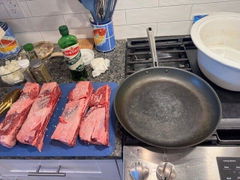
    Thaw the bison osso bucco portions in the refrigerator overnight. Pat dry on all sides with paper towels. Season generously with salt and pepper. If dredging, dust lightly with flour on the cut faces only — not the bone. Tie each shank around the equator with a piece of kitchen twine to keep the meat attached to the bone during the braise (this matters; bison shanks pull apart more readily than veal).
  2. Sear (10 minutes)

    Heat 3 tablespoons olive oil in a Dutch oven over medium-high heat until shimmering. Sear the shanks 3-4 minutes per side, including the round edges, until each face is deeply browned. Don't crowd the pot — sear in batches if needed. Transfer to a plate.
  3. Build the soffritto (10 minutes)

    Reduce heat to medium. Add the onion, carrot, and celery to the Dutch oven. Cook 6-8 minutes, stirring occasionally, until the vegetables soften and the onion turns translucent. Add the garlic and tomato paste; cook 2 more minutes, stirring constantly, until the tomato paste deepens to a brick red.
  4. Deglaze (3 minutes)

    Pour in the red wine. Scrape up the browned bits from the bottom of the pot with a wooden spoon. Let the wine simmer 2-3 minutes, until reduced by half.
  5. Build the braise (5 minutes)

    Add the stock, crushed tomatoes, bay leaves, rosemary, thyme sprigs, and lemon zest strip. Stir to combine. Return the shanks to the pot, nestling them into the liquid. The liquid should come about two-thirds of the way up the sides of the shanks; add more stock or water if needed.
  6. Braise (2.5 to 3 hours)

    Bring the pot to a gentle simmer. Cover with the lid slightly ajar. Transfer to a 325°F oven. Braise 2.5 to 3 hours, turning the shanks every 45 minutes. The osso bucco is done when the meat is fork-tender and pulling away from the bone but still holding together on the bone. Do not over-braise — past 3 hours the meat collapses entirely off the bone, which loses the dramatic presentation.
  7. Rest and finish the sauce (10 minutes)

    Remove the Dutch oven from the heat. Gently transfer the shanks to a plate; cover loosely with foil. Strain the braising liquid through a fine-mesh sieve into a saucepan, pressing the solids to extract their flavor. Skim any visible fat from the surface. Bring the strained sauce to a simmer over medium-high heat and reduce by one-third, 8-10 minutes, until glossy and slightly thickened. Taste and adjust salt.
  8. Plate (5 minutes)

    Spoon a portion of polenta, risotto, or mashed potatoes onto each plate. Top with a bison osso bucco shank. Ladle the reduced sauce over the meat and around the base. Sprinkle a generous spoonful of gremolata over the top. Serve with a small spoon for the bone marrow — the marrow is the prize.

Don't skip the marrow

Osso bucco translates literally to 'bone with a hole.' The hole is the marrow channel — and the marrow is the reward for the three-hour cook. After the braise, the marrow inside the bone has softened to the consistency of soft butter, infused with the wine and aromatics of the braise. Most home cooks don't know what to do with it.

Three ways to serve it:

The Approach How It Works
Spoon and spread

Hand each diner a small spoon (espresso spoon or marrow spoon) with the plated osso bucco. Spoon the warm marrow out of the bone and spread it on a piece of grilled bread, or fold it directly into the polenta or risotto on the plate. The bread approach is the classic Milanese move; the polenta approach is the modern restaurant version. Both work.

Fold into the sauce

Before plating, push the marrow out of the bone with a small spoon or paring knife and whisk it into the reduced sauce off the heat. The marrow emulsifies into the sauce, adding a richness and gloss that can't be faked. Particularly good if you're serving the dish over a simple pasta or buttered noodles rather than polenta.

Eat from the bone

The most traditional — just spoon it directly out of the bone and eat it as you go through the dish. Salt the warm marrow lightly with flaky sea salt for the best version of this. No utensil work, no plating, just the dish.

Whichever way you serve it: don't leave the marrow in the bone. It's the part of the dish that makes osso bucco osso bucco.

Slow cooker and pressure cooker variations

More techniques for slow-cooked bison below:

Slow cooker (Crock-Pot)

The Dutch oven approach is better — but the slow cooker works if it's what you have. Do the sear and the soffritto in a pan first; the slow cooker can't develop the same depth of flavor without those stages. Transfer everything to the slow cooker after the deglaze. Cook on low for 7-8 hours, or high for 4 hours. Strain and reduce the sauce on the stovetop before plating, the same as the oven method.

Pressure cooker (Instant Pot)

Faster but no shortcuts on technique. Use the sauté function for the sear and the soffritto in the Instant Pot itself. Add the liquid and the shanks, lock the lid, cook on high pressure for 45-50 minutes, then let the pressure release naturally for 15 minutes. Strain and reduce the sauce on sauté mode before plating. The texture is slightly different — the meat reads more 'fall-off' than 'pull-tender' — but the dish is excellent.

Why we partnered with Hightail Ranch

Hightail Ranch sits on 10,000 acres of Camas Prairie in Western Montana. Around 300 bison roam the land — that's roughly 33 acres per animal, in a category where conventional cattle stocking is closer to one or two acres per head. When Hightail says free-roaming, the math backs it up.

Jon Sepp and Brittany Masters built the operation from scratch. Jon spent his career in the military, testing parachutes; Brittany came from a corporate role in Seattle. Neither came from ranching families. Both are first-generation. They're veteran-owned and woman-owned, and they raise their herd with what they call low-stress handling — no interference outside of pasture moves and one annual run through the corrals to tag and health-check the animals.

Hightail's view, which is also ours: bison aren't just livestock. The way they graze and the way their hooves work the soil are part of what built the Great Plains in the first place. Without them, the ecosystem doesn't exist. Raising them well isn't sentimental — it's how the land gets restored.

That's the work we want on Valor. We don't put a ranch on the marketplace unless we'd buy from them ourselves, and Hightail clears that bar by a wide margin.

Nutrition & Sourcing

Bison runs higher in protein and lower in fat than the equivalent cut of beef. A 4 oz raw serving of Hightail bison delivers approximately 24 g of protein. The full nutritional profile depends on the specific cut and pack; see the panel on the brick for exact values.

Grass-fed AND grass-finished

No hormones, no antibiotics, no vaccines

AGA-certified (American Grassfed Association)

Single ranch, single source

Processed in a USDA-inspected facility

Bison Osso Bucco FAQ

The most popular questions about grass fed bison shank

Is it 'osso bucco' or 'osso buco'?

Both are correct. 'Osso buco' (single C) is the traditional Italian spelling; 'osso bucco' (double C) is the Italian-American spelling that's more common in U.S. butcher shops and home recipes. Hightail uses 'osso bucco.' The dish is the same; the technique is the same — it's a regional preference.

What's the difference between bison osso bucco and veal osso buco?

Same cut from the shank, same technique, same dish. The differences are in the meat itself. Bison eats deeper than veal — richer, slightly more mineral, with darker color in the finished sauce. The bone is larger and yields more marrow. Braise time is similar, around 2.5 to 3 hours. If you've made veal osso buco before, you already know the technique; you just need to lean into a slightly more assertive wine and aromatics to balance the bigger flavor. Full recipe and adjustments are above.

How long does bison osso bucco take to braise?

2.5 to 3 hours in a covered Dutch oven at 325°F. Turn the shanks every 45 minutes for even cooking. The osso bucco is done when the meat is fork-tender and pulling away from the bone but still attached to it. Do not over-braise — past 3 hours the meat collapses off the bone entirely, which loses the dramatic plate presentation. Slow cooker and pressure cooker variations have different timings; see the variations section
above.

Do I need a Dutch oven, or can I use a slow cooker?

A Dutch oven is the better tool — the cast iron holds and distributes heat in a way slow cookers can't, and the sear/soffritto/braise can all happen in the same pot. That said, the slow cooker works. The key adjustment: do the sear and the soffritto in a separate pan first, then transfer everything to the slow cooker. Skipping those stages produces a flat, under-developed sauce. Cook on low for 7-8 hours or high for 4 hours, then strain and reduce the sauce on the stovetop before plating.

What's the best wine to braise bison osso bucco with?

A dry, structured red. Chianti is traditional for veal osso buco; for bison's deeper flavor, a Sangiovese, Cabernet Sauvignon, or a Côtes du Rhône works better. Avoid anything too sweet or too jammy — the wine needs acidity to balance the rich braise. The rule we send members: cook with a wine you'd drink with the meal. Don't use cooking wine; it's a different product and it ruins the dish.

What should I serve bison osso bucco with?

The traditional pairing is risotto alla Milanese (saffron risotto), which is the Lombardian classic and the original accompaniment from Milan, where the dish originates. Creamy polenta is the most
popular American adaptation and works exceptionally well — the polenta soaks up the sauce. Buttered mashed potatoes are the simpler version and absolutely fine. Whatever you serve it with, the gremolata at the end is non-negotiable — the bright lemon, parsley, and garlic cut through the richness of the braise.

Is the marrow safe to eat? How should I serve it?

Yes, bone marrow is safe and is the most prized part of the dish. After the long braise, the marrow inside the bone softens to a spoonable, butter-like consistency infused with the wine and aromatics. Three ways to serve it: spoon it onto grilled bread or directly into your polenta; fold it into the reduced sauce before plating for a glossier finish; or eat it directly out of the bone with a small spoon and a pinch of flaky salt. The traditional Milanese move is bread; the modern restaurant approach is folding it into the sauce. Whichever way, don't leave the marrow in the bone.

Can I make bison osso bucco ahead of time?

Yes — and it gets better. Like most braises, osso bucco improves overnight. Make it the day before, cool the shanks and the sauce separately, refrigerate, and reheat the shanks gently in the reduced sauce on the stovetop or in a 300°F oven until heated through (about 20-25 minutes). The flavors deepen and integrate over the rest. This makes osso bucco ideal for dinner parties — most of the work is done a day ahead, leaving you free on the day of.

Recommended for You