Two raw bison tomahawk steaks on a wooden surface with salt and pepper.
Person holding a tray with reverse seared bison tomahawk steaks.
Two raw seasoned bison tomahawk steaks on a piece of parchment paper.
Two pieces of raw bison steaks on a wooden cutting board with a small bowl of salt.
Hightail ranch Cowboy holding a lasso in a fenced area with a warm, golden light.
Two Hightail Ranch bison standing in a grassy field with a blurred background
Grilled Bison tomahawk steak on a wooden cutting board with a rustic background
Hightail Regenerative Ranch with American Grassfed logo over a scenic landscape.

Bison Tomahawk — French-Cut, Bone-In | Hightail Ranch

Price
$127.50
$75.23 with Membership
Taxes and shipping calculated at checkout

Frequently Bought Together

Grass fed Ground Bison Product Information

The bison tomahawk, French-cut and bone-in, from Hightail Ranch in Camas Prairie, Montana. Three sizes, one cut, hand-trimmed to the bone.


Hightail Ranch raises bison the way bison are supposed to be raised — on 10,000 acres of Montana prairie, never grain, never hormones, never antibiotics, never even vaccines. The herd grazes rotationally on native grass year-round. We brought Hightail onto Valor because that standard matches ours.

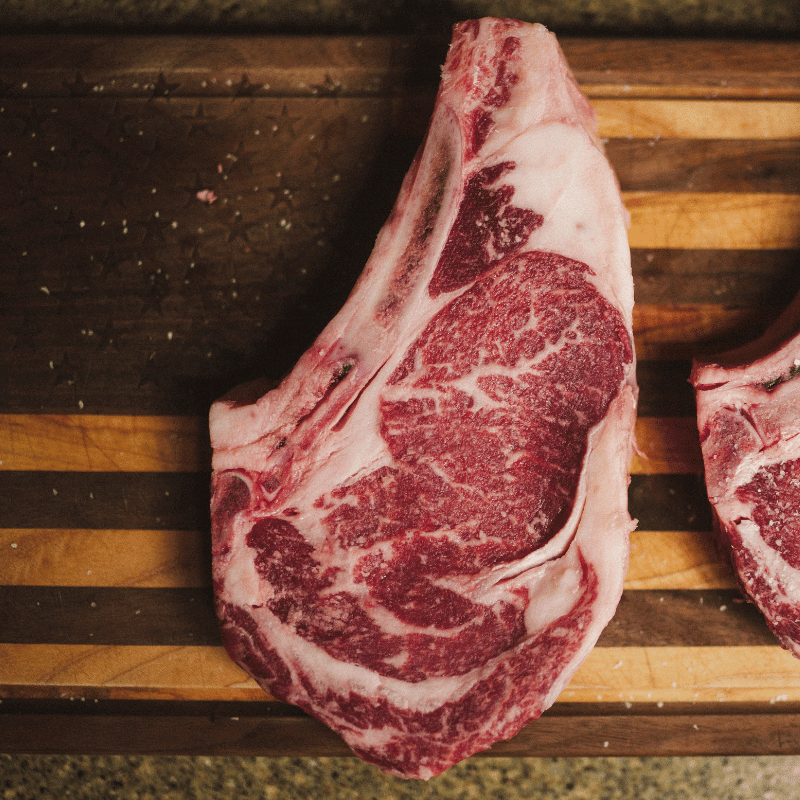
The tomahawk is the showpiece cut — a bone-in ribeye with the rib bone frenched clean for presentation. Bison ribeye eats leaner than beef ribeye, with the deeper, slightly mineral flavor bison is known for. The bone insulates the meat during the cook, which means a more even doneness from edge to center than you'll get from a boneless cut. This is the steak you cook when you want something to remember.

Three sizes. The 24-28 oz feeds two generously. The 32-40 oz is the best per-pound value and the size we recommend for most cooks. The 48-55 oz is the trophy cut — five available per harvest, when Hightail has them.


Bison Tomahawk Steak Specifications:

Weight 
(varies by variant)

24-28 oz selected: 24-28 oz per steak — serves 2

32-40 oz selected: 32-40 oz per steak — serves 2-3

48-55 oz selected: 48-55 oz per steak — serves 3-4 (trophy cut)

Cut

Tomahawk — French-cut, bone-in (bone-in ribeye)

Source

Hightail Ranch · Camas Prairie, Montana

Sourcing

Grass-fed and grass-finished · No hormones · No antibiotics · No vaccines

Certification

American Grassfed Association (AGA) certified

Pack

Single steak, vacuum-sealed, flash-frozen

Processing

Processed in a USDA-inspected facility

Shipping

Ships frozen with dry ice.

How to cook a Hightail bison tomahawk

The reverse-sear is the right method for a tomahawk of any size — and especially for bison, which has less margin for error than beef. You cook low and slow first, finish hot, and pull earlier than
you'd ever pull a beef tomahawk.


The bison adjustment.

Bison is leaner than beef. The same internal temp on a bison tomahawk eats more well-done than it does on a beef tomahawk. Pull 5–10°F earlier than you would for beef. Target a final temp of 130°F for medium-rare — which means pulling around 120°F before the sear. Past 140°F, you've ruined a $150 steak. Use a thermometer. There's no eyeballing this cut.


The reverse-sear method, step by step.

• Pull the steak from the freezer 24 hours before cook day. Thaw in the refrigerator, still in the vacuum seal.

• Take the steak out of the fridge 45 minutes before cooking. Pat dry with paper towels.

• Season generously with kosher salt and cracked black pepper on all sides, including the fat cap and the meat against the bone.

• Heat oven, smoker, or grill (set up for two-zone indirect heat) to 250°F.

• Place the steak on a wire rack over a sheet pan. Cook indirect until the internal temperature reaches the pull temp for your selected size (see table below).

• Rest the steak 10 minutes while you bring the sear surface up to ripping hot — cast iron over high heat, or grill over direct flame at 500°F+.

• Sear 60–90 seconds per side. Sear the edges by standing the steak on its side using tongs.

• Rest another 5 minutes. Slice against the grain off the bone, then into half-inch pieces.

Bison Tomahawk Steak Cook times by size (250°F indirect, then sear)

Size Indirect Cook Time* Pull Temp Sear Final Temp (after rest)
24-28 oz 35-45 minutes 118-120°F 60-90 sec per side 130°F — medium rare
32-40 oz 50-65 minutes 118-120°F 60-90 sec per side 130°F — medium rare
48-55 oz 70-90 minutes 115-118°F 90 sec per side 130°F — medium rare
*Cook times are guides, not gospel. A thermometer is the only honest answer. Pull temp matters more than minutes.

Why we partnered with Hightail Ranch

Hightail Ranch sits on 10,000 acres of Camas Prairie in Western Montana. Around 300 bison roam the land — that's roughly 33 acres per animal, in a category where conventional cattle stocking is closer to one or two acres per head. When Hightail says free-roaming, the math backs it up.

Jon Sepp and Brittany Masters built the operation from scratch. Jon spent his career in the military, testing parachutes; Brittany came from a corporate role in Seattle. Neither came from ranching families. Both are first-generation. They're veteran-owned and woman-owned, and they raise their herd with what they call low-stress handling — no interference outside of pasture moves and one annual run through the corrals to tag and health-check the animals.

Hightail's view, which is also ours: bison aren't just livestock. The way they graze and the way their hooves work the soil are part of what built the Great Plains in the first place. Without them, the ecosystem doesn't exist. Raising them well isn't sentimental — it's how the land gets restored.

That's the work we want on Valor. We don't put a ranch on the marketplace unless we'd buy from them ourselves, and Hightail clears that bar by a wide margin.

Nutrition & Sourcing

Bison runs higher in protein and lower in fat than the equivalent cut of beef. A 4 oz raw serving of Hightail bison delivers approximately 24 g of protein. The full nutritional profile depends on the specific cut and pack; see the panel on the brick for exact values.

Grass-fed AND grass-finished

No hormones, no antibiotics, no vaccines

AGA-certified (American Grassfed Association)

Single ranch, single source

Processed in a USDA-inspected facility

Grass Fed Bison Tomahawk Steak FAQ

The most popular questions about bone-in bison tomahawk steaks.

How is a bison tomahawk different from a beef tomahawk?

Same cut, different animal. The tomahawk is a bone-in ribeye, frenched to expose the rib bone for presentation. The differences are in the meat itself. Bison runs leaner than beef, with the deeper, slightly mineral flavor bison is known for. The cook is faster because there's less intramuscular fat to render, and the margin for overcooking is tighter — bison turns dry past medium where beef can still pass. The bone-in
structure helps here: it insulates the meat during the cook and gives you more even doneness from edge to center than you'd get from a boneless cut.

Which size should I order?

It depends on who you're feeding and how you want to serve it. The 24-28 oz feeds two generously and is the right pick for a date-night or two-person dinner. The 32-40 oz is the best per-pound value and works for two with leftovers or three at the table — most members who order tomahawks more than once settle on this size. The 48-55 oz is the trophy cut, sized for a table of three or four; Hightail releases five per harvest, and when they're gone they're gone until the next batch is ready.

How do I cook a bison tomahawk?

Reverse-sear is the answer, regardless of size. Cook low and slow in an oven, smoker, or two-zone grill at 250°F until the internal temp hits 118-120°F (or 115-118°F for the 48-55 oz). Rest 10 minutes, then sear 60-90 seconds per side on a screaming hot surface — cast iron over high heat or direct grill flame at 500°F or more. Rest another 5 minutes and slice. Full size-by-size cook times are in the cook guide above. The single most important rule: bison overcooks fast. Pull 5-10°F earlier than you would for beef and use a thermometer.

What internal temperature should bison be cooked to?

For medium-rare — which we recommend — pull at 118-120°F and rest to a final temperature of 130°F. For medium, pull at 125°F and rest to 135°F. We don't recommend past medium on bison; the leanness shows up fast as dryness above 140°F. The USDA's recommended minimum for steaks is 145°F, which on bison reads as well-done; the choice is yours, but most members who try medium-rare don't go back.


How long should I thaw a bison tomahawk before cooking?

24 hours in the refrigerator, still in the vacuum-seal. For a faster thaw, submerge the sealed steak in a sink of cold water for 2-4 hours depending on size; change the water every 30 minutes. Never
thaw at room temperature. After it's thawed, take the steak out of the fridge 45 minutes before cooking to take the deep chill off — that's the difference between a steak that cooks evenly and one that grays at the edges before the center is right.

How many people does a bison tomahawk serve?

24-28 oz serves two generously. 32-40 oz serves two to three. 48-55 oz serves three to four. Bison eats richer than the same weight of beef despite being leaner, so portion sizes can run slightly smaller without anyone feeling short-changed. As a baseline, plan on 6-8 oz of cooked weight per person for dinner; bone weight is roughly 25% of the packaged weight.

Is Hightail bison grass-fed and grass-finished?

Yes — both. We've verified directly with Hightail Ranch that their bison are 100% grass-fed and grass-finished. They eat no grain of any kind, are raised without added hormones, without antibiotics,
and without vaccines. Hightail is certified by the American Grassfed Association (AGA), which is the standard we look for when evaluating any grass-fed claim.

How does Hightail bison ship?

Frozen, in insulated packaging with dry ice.
Standard 1-3 day handling and 1-3 day transit nationwide. Because the steak is perishable and ships frozen and arrives frozen.

Recommended for You